Sunday, November 28, 2010

Human Cloning ... Yes or No?

Science is a two-edged sword. There’s no question about that. On one hand there’s research on the cure for cancer, Alzheimer’s etc. and on the other hand there are activities taking place on poison gas, nuclear weapons and genetic engineering. A Persian poet, Saei, stated that ”One with knowledge has a greater capability to cause harm; just as a thief with a torch will cause a greater damage.” In the modern world, improvement and development of science and technology is accelerating extremely rapidly; but what are the boundaries? What are the limitations?


A keen development of the 20th century is genetic modification. It has grown so much and holds so much potential that a tertiary course by the name of “Genetic Engineering” has been tagged on to it. The means of this branch of science is to alter an individual’s genes to enhance the quality of competency in life. Genetic engineering can be practiced on all living organisms but the main focus of this essay is the different views on human genetic engineering or more specifically, human cloning.

The proponents of human cloning state that cloning is no more un-natural than binary fission, the method in which bacteria reproduce to produce identical copies of themselves; and it is no more un-ethical than giving birth to identical twins. Just as identical twins have exactly the same genome yet may grow up with different personalities; so in cloning where the genes between the original specimen and the cloned specimen are identical, the cloned specimen might have different characteristics due to being produced in a different time period.

The opponents of human cloning state that human genetic engineering is morally, ethically, religiously and practically unsound. They believe that human cloning can lead to the impairing or ruining of one’s individuality, the decrease in the diversity of the human gene pool and the unnatural growth of the world’s population due to the ease of reproduction. Also, many religions object to human cloning, proclaiming that it is “playing God”.

The fact is that, what separates humans from other living organisms is the power to think and the power to decide. For example, when an animal wants to defend itself from a predator, it puffs its hair, creates sound, stomps and shows its claws; never has an animal defended itself using a sword or gun. A human being is always on the verge of experimenting and inventing to make life a more smooth and relaxing ride. This shows that only a human being is capable to decide based upon thinking. Though the power of thinking and decision of a human being is extremely precious and useful, the boundaries which are set by factors such as one’s religion and culture must also be obeyed.

From the Bible’s point of view, human beings are created in the image of God and are unique and individual. Human cloning denies this rule by impairing or destroying this individuality. In addition, if humanity were to be created through cloning, there must be a creator. In the case of human genetic engineering, the creator would be a human being. According to the Bible, God is the only one who rightfully exercises sovereign control over human life. To attempt to control such things is to place oneself in God’s position. Clearly, man is not to do this. Other religions such as Islam also hold a similar opinion towards human cloning.


Imagination sometimes overrules knowledge; this causes a visionary view of the future and often leads to development and improvement. But this factor should never overrule the boundaries and limitations set for a human being.

Tuesday, November 9, 2010

The Giant red-headed Centipede: a crawling dragon

When the words centipede and milipede strike one's ears, the mind's engine will display results of tiny, slow and harmless creatures with many legs. Well, this essay will provide a completely different side to these creatures generally refered to as Myriapoda s.

The Giant red-headed centipede is a subspecies of the Giant desert centipede and is truley giant, reaching lengths of 10 inches, or 25 centimeters. The Giant red headed centipedes are sometimes referred to as "the devil's head"; this is because of the color designition of the different body segments of the centipede. The top few segment are red and the rest are all black. The legs are yellow.

These creatures are mostly found in the USA and Mexico and being moisture dependent, choose moist habitats. Even in deserts they rely on moisture and are found in cracks in woods and beneath rocks near ponds. The females hatch eggs to reproduce and wind themselves around the eggs for prottection.

The dining menu of these predators consists of moths, toads, snakes and other vertebrates. They capture and kill their prey by stunning them and killing them using their poison domes situated in thebasal section of their fangs, also called maxillipeds. The video bellow is a short documentary which also portrays the hunting abilities of a giant red headed centipede.


In the mid 1920s, Dr. Baerg tested the effect of the venom by inducing a centipede to bite one of his little fingers, leaving the fangs inserted for about four seconds. The bite was followed by a sharp and strictly local pain, which began to subside noticeably after about 15 minutes. In about two hours the pain was only very slight, but there was a general swelling in the finger. Three hours after the bite, most symptoms had disappeared. What some do for science ! It has been stated by a famed arthopod scientist, J. L Cloudsely that "centipedes seem to exert a weird fascination on the morbid appetites of the hysterical and insane."

When the animal is irritated, a poison is created at the base of each of its legs and inserted into the source of irritation. The toxins in the venom cause wounds and swelling and if inserted in critical areas of the body, such as the chest, can eventually lead to death.

Tuesday, September 28, 2010

The Kiwi bird


The kiwi is a deliscious green fruit but this essay is about the native New Zealand bird. Before the arrival of humans in New Zealand, very few species of animals existed in the small pacific island. So it is known that the kiwi hasn't originated in New Zealand. It was for sometime thought that the Kiwi's closest family is the Moa but later on DNA examinations have been carried out and the results show that the Moa's genes are much more alike the Ostrich of Africa while the genes of the Kiwi are more simmilar to that of the Australian Emu. So it is thought that the Kiwi is a import of the neighbouring country. 


Meanwhile, the Kiwi is a proud representative of its country. The figure is seen on the coins, on military badges and the name is also tagged on many companies and organizations. 

During the Second World War, the phrase "kiwi" was used to refer to the New Zealander soldiers and nowadays the term is used much more vastly to replace the word "new zealand". 


Kiwis are classified as ratites, a category of flightless birds, and are found in 5 main species, all of which are endangered. The species and some of the characteristics are shown in the table bellow: 

-->

Specie Name
Height
Weight
 Habitat
1
45 cm
3.3 kg
North Island
2
25 cm
1.4 kg
Kapiti Island
3
23 cm
1.2 kg
North & South Island
4
44 cm
3.2 kg
South Island
5
40 cm
2.5 kg
North Island

A interesting fact in regards with the physical features of kiwis is that on average, females tend to be slightly heavier and bigger than the males!


Kiwis prefer living in habitats such as beech forests and sub tropical temperate areas but due to the existence of so many mammalian predators, they are forced to inhabit a wider range of location such as mountain areas. 


These birds are nocturnal in the wild but in sanctuaries where the fright of predators isn't existent, they are seen in daylight as well.

The dining menu of a kiwi is a fairly wide list, consisting of seeds, invertebrates, grubs, crayfish, fruit and sometimes small amphibians. The nostrils of a kiwi are placed at the tip of the beak unlike many other birds. This makes it easy to eat worms under the ground without seeing or sensing them and rather by smelling them. Kiwis are aided with very strong sense of smell but a rather week sense of sight. 


Kiwis are one of the exceptions in the birds category that doesn't have a preen gland. Preening is the compressed word for personal grooming and a preen gland is a gland which secretes a type of waxy material which acts as both a water resistant layer and a anti-parasite layer. Too bad!


Once bonded, the male and female kiwi stick live the entire life together as monogamous couple, meaning owning one partner in regards of marriage and reproduction. Loyal birds! 
It takes about a month for a completely developed egg to form in the female kiwis body. During this time, the female must eat 2-3 times the amount which she usually consumed but in the last few days prior to the laying of the egg, the egg will have taken up so much space that the female's stomach won't have enough room to host any food, meaning she must fast!

Speaking of eggs, the egg of a kiwi is a greenish whitish color and can weigh up to a quarter the weight of the female kiwi.And being approximately the same size as an average chicken, the kiwi egg is about 6 times bigger than a chicken egg. To add up this piece of information, the kiwi bird has the largest egg out of all birds in comparison to its body size. 
Anyway, after the egg is laid, both the male and the female will take care of the egg. Again, very loyal. The Great spotted kiwi is the only exception which leaves all the responsibilities on the female's shoulders. The incubation period is about 2 months.


The Maori once hunted the kiwi bird as a food source and to make ceremonial cloaks but now consider themselves the guardians of the flightless bird and only use the feathers of the killed kiwis rather than the hunted ones; meaning those killed in road accident, etc.


Monday, June 21, 2010

Excess Weight: the symptoms & do-s and donnot-s

-->

Every person, according to his/her physical features, should have a specific weight. This specific amount is calculated with the beneath formula:
(Body Mass Index = BMI) = Mass/Height ²

The normal amount is around 25
25  to  30 :   Overweight  
30 + :           Obesity

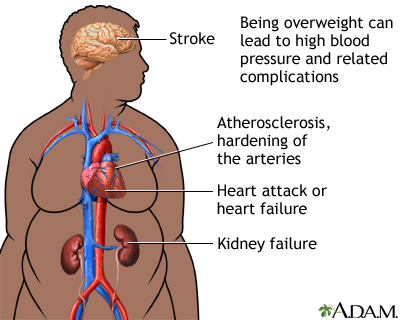
A few of the diseases leading from excess weight include: 
1) Diabetes:

Extra weight can be a trigger of diabetes, especially type 2 = Melitus. Diabetes type 2 is the disorder of the body not being able to use insulin effectively. In Diabetes type 2 the body can’t control the blood sugar levels and problems in the kidney, eye and heart can occur in response
Statistically, overweight people are twice as likely two have diabetes type 2.


2) Heart Problems:

The heart is the body’s pump. Imagine a water pump in an apartment; take the water pump for the heart in the body and the pipes as the vessels. After many years, some things will start sticking to the walls of the pipes and this will narrow the water pathway. This means that if the households want the same amount of water, they need to turn the water pump up a notch so that it will work harder.
The same thing happens in our body when fats such as cholesterol and triglyceride stick to the vessel walls. Overall, it causes the blood pressure to fly into the skies. 


3) Joint and Bone Disorders:

Osteoarthritis usually happens on the joint of the knees, hips and lower back. Due to being put under pressure, the cartilages wear away. Gout is also a joint disorder caused by high levels of uric acid in blood.

There are many other problems and disorders roaming around and searching for the right case to knock out. And the interesting point is that they are linked with one another, so try to avoid them and fight them with the few methods mentioned bellow:   

1) Physical Activity:Think of exercise as a food group in your diet”

2) Munch up colourful FRUITS and VEGETABLES: vitamins, no/low cholesterol, antioxidants, fiber.

3) Cut down on SALT, SUGAR and BUTTER.

4) Some people believe:  "The only way to keep your health is to eat what you don't want, drink what you don't like, and do what you'd rather not." -Mark Twain. But I believe that this is the correct statement: “Try not to think of certain foods as ‘off limits’;  Think smaller portions!”

5) Drink an ocean of WATER: hydration, filteration

6) Eat more healthy carbohydrates and whole GRAINS: long lasting energy, protect against coronary heart disease, certain cancers, and diabetes. beans, potato, bread,…

7) FIBER: Feel full faster and longer, keeps blood sugar stable; beans, oat, fruits, vegies,…


8) Low consumption of BAD OILS. But enough of the GOOD OILS:

plant oils like canola oil, peanut oil, and olive oil, as well as avocados, nuts (like almonds, hazelnuts, and pecans) and seeds (such as pumpkin, sesame), fish oils, corn, walnut.


9) Focus on quality sources of PROTEIN, like fresh fish, chicken or turkey, eggs, beans or nuts.

10) “It's not just what you eat, it's HOW you eat” Take time to CHEW your food, Listen to your body: It actually takes a few minutes for your brain to tell your body that it has had enough food, so eat slowly.


11) Eat breakfast, and eat smaller meals throughout the day.


Here are some  statistics on Excess Weight:
  • Over 58 million Americans are overweight;
  • Over 40 million Americans are obese
  • More than 80% of Americans do not engage in adequate physical activity;
  • More than one quarter of all Americans are considered to be "completely sedentary"
  • More than 85 percent of all diabetes cases are due to obesity and being overweight;
  • More than 70% of all heart-related disease is heavily correlated with being overweight and/or obese;
  • Almost 45% of all breast and colon cancer cases are heavily related to obesity and/or being overweight;
  • More than 30% of all gall bladder operations are caused by obesity and/or being overweight;
  • More than one quarter of all obese people have hypertension (high blood pressure);
  • Only 4 percent of children were considered obese in 1982. Now, more than 30% are.
  • More than one quarter of all obese children are showing symptoms of the development of Type 2 diabetes mellitus;

References:
   
     2) http://ezinearticles.com/?Obesity-Statistics---The-Facts-Presented-by-Modern-  Research- on-Obesity&id=1919602