Monday, June 21, 2010

Excess Weight: the symptoms & do-s and donnot-s

-->

Every person, according to his/her physical features, should have a specific weight. This specific amount is calculated with the beneath formula:
(Body Mass Index = BMI) = Mass/Height ²

The normal amount is around 25
25  to  30 :   Overweight  
30 + :           Obesity

A few of the diseases leading from excess weight include: 
1) Diabetes:

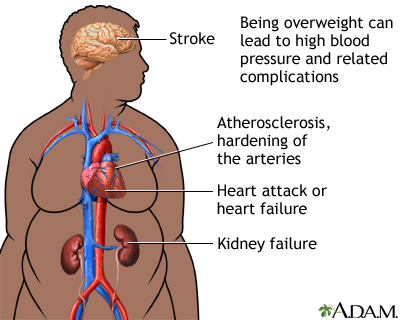
Extra weight can be a trigger of diabetes, especially type 2 = Melitus. Diabetes type 2 is the disorder of the body not being able to use insulin effectively. In Diabetes type 2 the body can’t control the blood sugar levels and problems in the kidney, eye and heart can occur in response
Statistically, overweight people are twice as likely two have diabetes type 2.


2) Heart Problems:

The heart is the body’s pump. Imagine a water pump in an apartment; take the water pump for the heart in the body and the pipes as the vessels. After many years, some things will start sticking to the walls of the pipes and this will narrow the water pathway. This means that if the households want the same amount of water, they need to turn the water pump up a notch so that it will work harder.
The same thing happens in our body when fats such as cholesterol and triglyceride stick to the vessel walls. Overall, it causes the blood pressure to fly into the skies. 


3) Joint and Bone Disorders:

Osteoarthritis usually happens on the joint of the knees, hips and lower back. Due to being put under pressure, the cartilages wear away. Gout is also a joint disorder caused by high levels of uric acid in blood.

There are many other problems and disorders roaming around and searching for the right case to knock out. And the interesting point is that they are linked with one another, so try to avoid them and fight them with the few methods mentioned bellow:   

1) Physical Activity:Think of exercise as a food group in your diet”

2) Munch up colourful FRUITS and VEGETABLES: vitamins, no/low cholesterol, antioxidants, fiber.

3) Cut down on SALT, SUGAR and BUTTER.

4) Some people believe:  "The only way to keep your health is to eat what you don't want, drink what you don't like, and do what you'd rather not." -Mark Twain. But I believe that this is the correct statement: “Try not to think of certain foods as ‘off limits’;  Think smaller portions!”

5) Drink an ocean of WATER: hydration, filteration

6) Eat more healthy carbohydrates and whole GRAINS: long lasting energy, protect against coronary heart disease, certain cancers, and diabetes. beans, potato, bread,…

7) FIBER: Feel full faster and longer, keeps blood sugar stable; beans, oat, fruits, vegies,…


8) Low consumption of BAD OILS. But enough of the GOOD OILS:

plant oils like canola oil, peanut oil, and olive oil, as well as avocados, nuts (like almonds, hazelnuts, and pecans) and seeds (such as pumpkin, sesame), fish oils, corn, walnut.


9) Focus on quality sources of PROTEIN, like fresh fish, chicken or turkey, eggs, beans or nuts.

10) “It's not just what you eat, it's HOW you eat” Take time to CHEW your food, Listen to your body: It actually takes a few minutes for your brain to tell your body that it has had enough food, so eat slowly.


11) Eat breakfast, and eat smaller meals throughout the day.


Here are some  statistics on Excess Weight:
  • Over 58 million Americans are overweight;
  • Over 40 million Americans are obese
  • More than 80% of Americans do not engage in adequate physical activity;
  • More than one quarter of all Americans are considered to be "completely sedentary"
  • More than 85 percent of all diabetes cases are due to obesity and being overweight;
  • More than 70% of all heart-related disease is heavily correlated with being overweight and/or obese;
  • Almost 45% of all breast and colon cancer cases are heavily related to obesity and/or being overweight;
  • More than 30% of all gall bladder operations are caused by obesity and/or being overweight;
  • More than one quarter of all obese people have hypertension (high blood pressure);
  • Only 4 percent of children were considered obese in 1982. Now, more than 30% are.
  • More than one quarter of all obese children are showing symptoms of the development of Type 2 diabetes mellitus;

References:
   
     2) http://ezinearticles.com/?Obesity-Statistics---The-Facts-Presented-by-Modern-  Research- on-Obesity&id=1919602


Saturday, June 12, 2010

Professor Hesabi: a glance at the incredible life


Mahmoud Hessaby was born on the 23 February 1903 in Tehran. Both his parents, Goharshad and Abbas were from the beautiful city of Tafresh, located in central Iran. He is the second child of his family, having an older brother only a year above him.


He married at a high age, 47, to Sadigheh Haery and has two fruits in his colorful and vivid life: Iraj (the older son) and Anoosheh (his beloved daughter). Before the world fare welled this extraordinary man on behalf of his pure spirit and accomplishments, he also had the pleasure of seeing his two grandchildren: Parishad and Parsa.


Prof. Hessaby has been merited university degrees in the fields of Persian Literature, Mathematics, Astronomy, Biology, Law, many branches of Engineering and finally settled with a Doctor of Philosophy in Physics. Prof. Hessaby is the only Iranian student of the mighty Proffesor Einstein and has been tagged the "Father of Physics", "Father of Modern Engineering" and "Father of Modern Science" in his country. No wonder some refer this man as a "polymath".


Friday, May 21, 2010

Kangaroo: the Australian Boxer


Kangaroos are herbivorous marsupials which are native to Australia. A famous myth which explains where the name of this animal is derived from, is as so: Captain Arthur Cook (the explorer who first found Australia) and a fellow explorer of his were searching the area when they saw a kangaroo. They asked a native of that area (an Aboriginal) for the name of the creature. The person said something which has been recorded as “Kangaroo” or “Kangaru” which in the aboriginal language means “I don’t understand what you are saying”. Captain Cook took this response as the name of the creature and so it was named “Kangaroo”.


There are four main species of Kangaroo. The table bellow displays the names as well as their habitat:
Specie name
Habitat
Other information
Red Kangaroo
The arid and semi-arid Central Australia
-Up to 2 meters tall
-Up to 90 kilograms
Eastern Grey Kangaroo
The fertile Eastern Australia

Western Grey Kangaroo
-Southern part of Western Australia
-South Australia
-Up to 54 kilograms
Antilopine Kangaroo
Northern Australia


Note: From top to bottom the specie’s physical feature (height and weight) decreases.


Male kangaroos are called bucks, boomers or jacks, females are called flyers or jills and young ones are called joeys. A group of kangaroos is called a mob, troop or court. These marsupials have large and powerful hind legs, large feet which are adapted for leaping and a long and muscular tail which aids kangaroos in keeping balance. The tendons (rope like feature which attaches the bone and muscle) of the hind legs of kangaroos are long and stretchy and can store a lot of elastic energy. This reduces muscle involvement and effort when leaping.


Like other Marsupials, female kangaroos have pouches which are also called marsupium. After a gestation period of approximately 31 to 36 days, a very small joey which has only somewhat developed forelimbs makes its way into the pouch. It will stay in the pouch for about 9 months for the postnatal development to complete. The joey will feed off its mother’s milk during the 9 months in the pouch and about 9 months after it comes out. 


A female kangaroo is always pregnant which means that a new born can exist while a joey is still in the pouch. In these situations the female has the ability to pause the development of the new born (or embryo as it is also called) until the joey leaves the pouch. This act which is called diapause, happens in places where food and water rates are low. At these times, the mother can produce two different types of milk simultaneously (one for the new born and the other for the joey).                                      
The average life expectancy of kangaroos is 4 to 6 years.


Some kangaroos are nocturnal (active at night time) and others are crepuscular (active in twilight which is just before sunrise and times between sunset and full night). They often spend the days resting in shades.


Kangaroos are herbivorous and eat foods such as grass, shrubs, fungi etc. The kangaroo has few predators including dingoes and foxes.

They can defend themselves by using their powerful hind legs to kick or if close to water they will demonstrate their swimming talent and attempt to hold the creature under water (with the use of its forehands) until it drowns. They are also keen runners and can reach top speeds of 70 km/h.

The conflict of kangaroos with cars, mostly happens at twilight hours. One reason is that, the kangaroos come to feed at these times and the second reason is that their eyes get blinded when the headlight of vehicles point towards them. This startles them and increases the chance of them jumping towards the car.

Tuesday, May 18, 2010

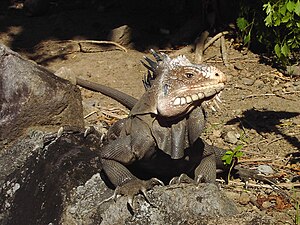
Iguana: the dragon-like reptile


Iguana is a type of lizard which consists of two species and is found in tropical areas of Central and Southern America as well as some of the Caribbean islands. The two species of Iguana which will be briefly assessed are: the Green Iguana and the Lesser Antillean Iguana.

These herbivorous reptiles have a dewlap (fold of skin which hangs under the throat and which helps in the regulation of the body temperature), a row of spines which run down their back and end at the tip of the tail, spikes behind their head and a delicate ear on each side which lays lower behind the eye.

The diet of these animals (both species) consists of leaves, flowers, fruit and many other species of plants.


1) The Green Iguana:

This specie of the iguana which is generally 1.5 to 2 meters in length with an approximate weight of 10 kilograms is native to Central and Southern America. Green Iguanas which are diurnal (active at daytime) are mostly found where there is water and on trees. Although they tend to stay on the ground in cold weather as it is warmer.


Green Iguanas are very good climbers and can fall from great heights without getting hurt. They are also talented swimmers; gliding through the water by moving their strong and powerful tail from side to side.
Their vision in low-light is fairly weak but instead they have special cells which give them a strong vision; so strong that they can even see the ultraviolet wave lengths. This aids them in making sure that they absorb enough sunlight in order to produce enough Vitamin D (which prevents bone diseases).


Strangely, Green Iguanas have a third eye on the top of their head which can only detect movement. This is very useful as it can detect predators that might be stalking it from above.

The Green Iguana’s main predators are hawks. These Iguanas are so frightened of hawks so that when the bird screams or whistles, the Iguana freezes, making it easier to be captured. Generally when the Green Iguana is threatened, it will try to escape (either by running or swimming away if water is close-by). At times it will try to threaten the predator by puffing up its body (in order to look bigger) and making sounds or even striking at it, using its powerful tail, sharp claws or its strong bite.


A strange fact is that, if a Green Iguana is grabbed on the tail by the predator it has the ability to break its tail. It will then escape and the tail will re-grow. This is useful for a creature which has to carry an approximately 80 centimeter tail everywhere it goes!

Despite its name (Green Iguana), the color of this specie varies according to the region which it lives in. It can be found in pink, orange, blue, black and a few other colors.


2) The Lesser Antillean Iguana:

This specie of Iguana which is between 1.2 and 1.5 meters in length, lives in woodlands, rainforests and mangroves of the Caribbean. A way to distinguish Lesser Antillean Iguanas from their cousins is by the round scale under the ears which the Green Iguanas have and the Lesser Antillean Iguanas lack. 

Monday, May 10, 2010

Computer Hardware in Brief

Computer is a very complex system just like the human body. We have organs and neurons and computers have devices and cables. In the next few paragraphs, the hardware of the computer will be magnified and briefly described.

CPU: 

The Central Processing Unit or the Processor is the brain of the computer - though considered with zilch intelligence as it is only able to follow instructions.

Every order we give to the computer is sent to the CPU in the computer language (1s and 0s), is then analyzed and finally a reply is sent back in whatever language we have chosen - English, German,...


RAM & Hard Disk Drive:


Random Access Memory is the temporary memory of the computer. RAM is like scrap paper that holds your work while you are working on it or editing it. But as soon as the power is cut, nothing will be saved. For example, RAM is holding up my article while you are reading it right now ; if you haven't saved it and the computer is turned off no trace of it will be found when you turn your computer on again.  


That's where the Hard Disk Drive comes to save the day. The Hard Disk Drive is the storage pot of the computer. Whenever you click on the save button, your work will be sent to the HDD. It will be stored there for you to reuse whenever you want.


Now, whenever you want to open a file, the CPU will go searching for it in the HDD and then send it to RAM - the temporary memory - to hold it up while you manipulate it.


Motherboard:

This is board inside the case which contains many devices which are all joined with each other. This board is the Central Nervous System of the computer which the CPU and most of the cards (see titles bellow) plug into. 


Video Card: 

This is a chip - not eatable - which transfers the digital information into the chosen format and displays everything onto the monitor.


Sound Card: 

The sound card is responsible for putting out the audio files through the speaker or headphones.